SEO for a Power and Hand Tools Online Store
About the project
- Site type
- Online store
- Niche
- Professional power and hand tools, tile and stone equipment
- Location
- US, Canada
- Language version
- English
- Domain age
- 24+ years
- Engagement period
- – present9 months, as of
Key result
Organic traffic grew 2.4× (+143%), and the share of keywords in Google’s Top 10 rose from 32% to 83%. The number of keywords the site ranks for grew 2.1×.
These results were achieved with partial implementation of the recommendations, so there is still room for further growth.
Results over time
Organic traffic from Ahrefs for the last year ( – , as of )
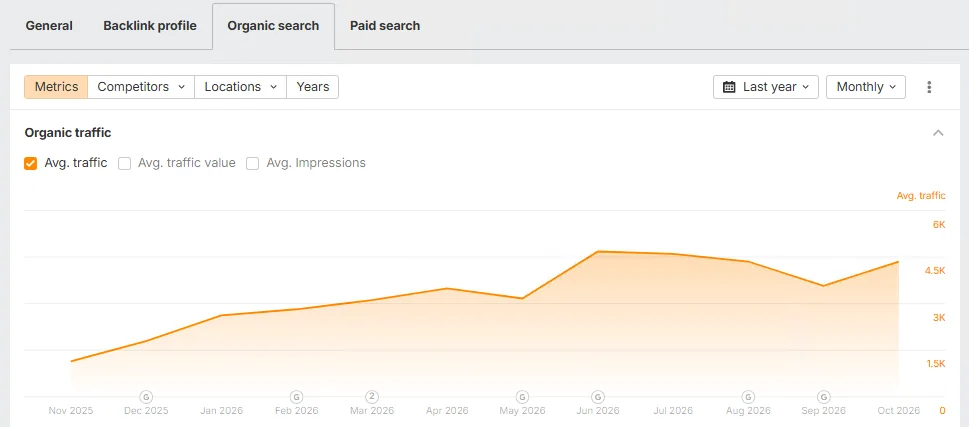
Organic traffic according to Ahrefs
2.4× increase (+143%)
Google keyword rankings according to Ahrefs ( – , as of )
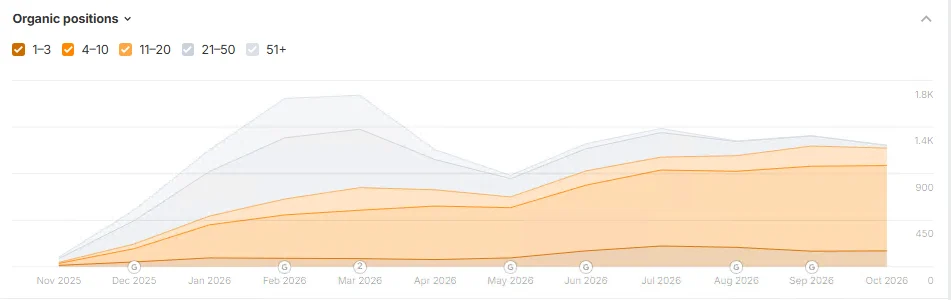
Rankings according to Ahrefs
| Metric | December 2025 | October 2026 | Change |
|---|---|---|---|
| Total keywords | 549 | 1,175 | 2.1× |
| Top 3 | 47 (9%) | 154 (13%) | +4% |
| Top 10 | 175 (32%) | 978 (83%) | +51% |
| Top 20 | 220 (40%) | 1,147 (98%) | +58% |
% — share of all keywords the site ranked for in Google on the snapshot date.
Detailed breakdown
Problem
The client wanted to increase organic traffic to the site’s commercial pages and improve their rankings. Despite the domain’s age, the site had only recently started ranking in search and getting traffic.
These problems stood in the way:
On-page
- Cannibalizing pages: exact duplicates and near-duplicates (headings, meta tags, content), including full copies of brand pages and blog posts
- Irrelevant H1s: headings reflected only the product type rather than the substance of the page, so pages with different content (for example, cordless and corded tools of the same type) had identical H1s
- The product mix in some categories didn’t match their content and search intent
- Poorly optimized meta tags: low-quality templates for category, subcategory, product, and brand pages, plus duplicate titles and descriptions
- No optimized SEO copy on many important pages
- The site structure didn’t cover part of the search demand: pages were missing for existing queries (for example, filters by brand and tool type)
Technical
- Technical duplicate pages generated by parameters (currency switching, sorting) that weren’t properly blocked from indexing
- Faulty pagination: a duplicate of the first page, endless generation of nonexistent pages, and SEO copy repeated on every paginated page
- Missing or faulty structured data (Organization, WebSite, Product, CollectionPage and ItemList for categories, BlogPosting, and Open Graph)
- Other technical errors: problems with breadcrumbs, some pages displaying incorrectly, errors in robots.txt and the XML sitemap, internal links with 301 redirects and links to 404 pages, etc
Usability, conversion, and trust factors
- Product pages lacked important sections: specification tables with links to categories and brands, reviews with structured data, shipping, payment, and return terms, related and recently viewed products, etc. The descriptions were also poorly structured
- Category and blog post pages had almost no internal linking sections (popular subcategories and brands, top products, etc.)
- No live chat for customers to reach the store
- The homepage was not informative enough and had limited internal linking
E-E-A-T
- The site lacked elements that confirm the company’s expertise and trustworthiness (detailed company information, certificates, awards, partner recommendations, etc.)
- Informational pages (shipping, payment) were too brief and didn’t answer typical customer questions
- Google Business Profile reviews needed more active management
Solution
- Competitor and site structure analysis, with suggestions for expanding the structure
- A technical audit, preparing specs for developers, and monitoring the implementation
- A comprehensive audit (conversion and trust factors, usability, E-E-A-T) and specs for developers
- A page cannibalization analysis, with recommendations for eliminating duplicates and separating pages by search intent
- On-page optimization: rolling out meta tag templates for categories, subcategories, products, and brands, preparing relevant H1s, titles, and descriptions, and adding internal links within copy
- Preparing briefs for copywriters on SEO copy for pages, accounting for target keywords, text structure, semantically related terms, and internal links to other relevant pages
Result
Reworked meta tags, fixes for some of the technical errors and duplicate pages, refined structured data, and new optimized SEO copy helped the site rank better in search engines. Organic traffic grew more than 2× (from 1,792 to 4,355 visits per month), and the number of keywords in Google grew 2.1×. The share of keywords in the Top 10 rose from 32% to 83%.